Friday, February 13, 2015

France in a box, a shopping trip to Strasbourg

A week or so ago, a friend (who lives in the USA) happened to mention that her soon to be ten years old daughter really wants to go to France. This led to the idea that for her birthday "Mademoiselle" (not her real name, shhhh) should receive a box full of French goodies, bought right in France for her birthday.  What could be more fun than that, right?

Well, maybe doing Mom's shopping for her could be.  Marika and I (and a friend) headed up on Friday to enjoy a day of looking for the best ways to represent France, for a young lady, that will fit in a small box and mail easily, trying to create a blend between the real thing and that mythical beret wearing version us Americans tend to think of, and we had a blast doing it.

The thought of driving in the heavy traffic, and on the narrow streets, and worse cramming into a parking space or garage near old town Strasbourg always makes my stomach churn, and with Dave's new car being less than 2 weeks old, I was even more loath than normal to try it.


So, I got busy online and found out that Strasbourg has a series of Park and Ride lots on its outskirts where you can park for only 4.10€ (up to 4.70€ for one more in demand lot) per day and that price includes free public transit for all passengers (up to 7) all day!  HOW did I miss knowing this all these years?  I am never, and I do mean NEVER parking downtown again.  I parked at the Rives de L'aar garage.  While it is a garage, it is the roomiest one I have seen in Europe, so simple to drive in.  Look at all that space!  Wow, wow, wow:

The trams stop was just around the corner and easy to find.  It was about a ten minute ride into the heart of the tourist areas of the city.  The trams in Strasbourg are nice and clean and really, really bright with huge floor to ceiling windows.


The trams are very long and have several accordion style joints.  We were about one third of the way back and this is looking out towards the front as the driver was already curving ahead of where we sat.

Once downtown, the first thing we found, that seemed both French and of interest to Mademoiselle was a soap shop:


We came away from the soap shop with two very cute little "soap kabobs," each of which has two different scented soaps on it (plus pretty ribbons and wire balls).  You can see them below, along with a tween girl magazine (hopefully there are enough photos to make up for Mademoiselle's lack of French reading skills) and a birthday card that we picked up along the way.


One of the BEST things to buy in France is food.  We love their cheeses, and their bakeries. Oh the bakeries.  Those items won't ship well or taste good once they get there, but we thought we needed to at least take some photos for everyone to drool over, because to a very large extent, this IS what a visit to France is all about:


Oh how I wish those tastes and smells could travel easily and well.  Le sigh.

We couldn't drool over the food all morning though, so we continued towards the center of town.  Our next stop was the very colorful and whimsical collection at Pylones, a shop based out of Paris, where we found a cute little travel hair brush/mirror and a fancy schmancy box to put all the treasures in.  


Pylones is RIGHT downtown, here is the view from their front door:  


This put us in the prime location to pick up those tourist specific items, like a mini flag, beret, and an Eiffel Tower keychain:


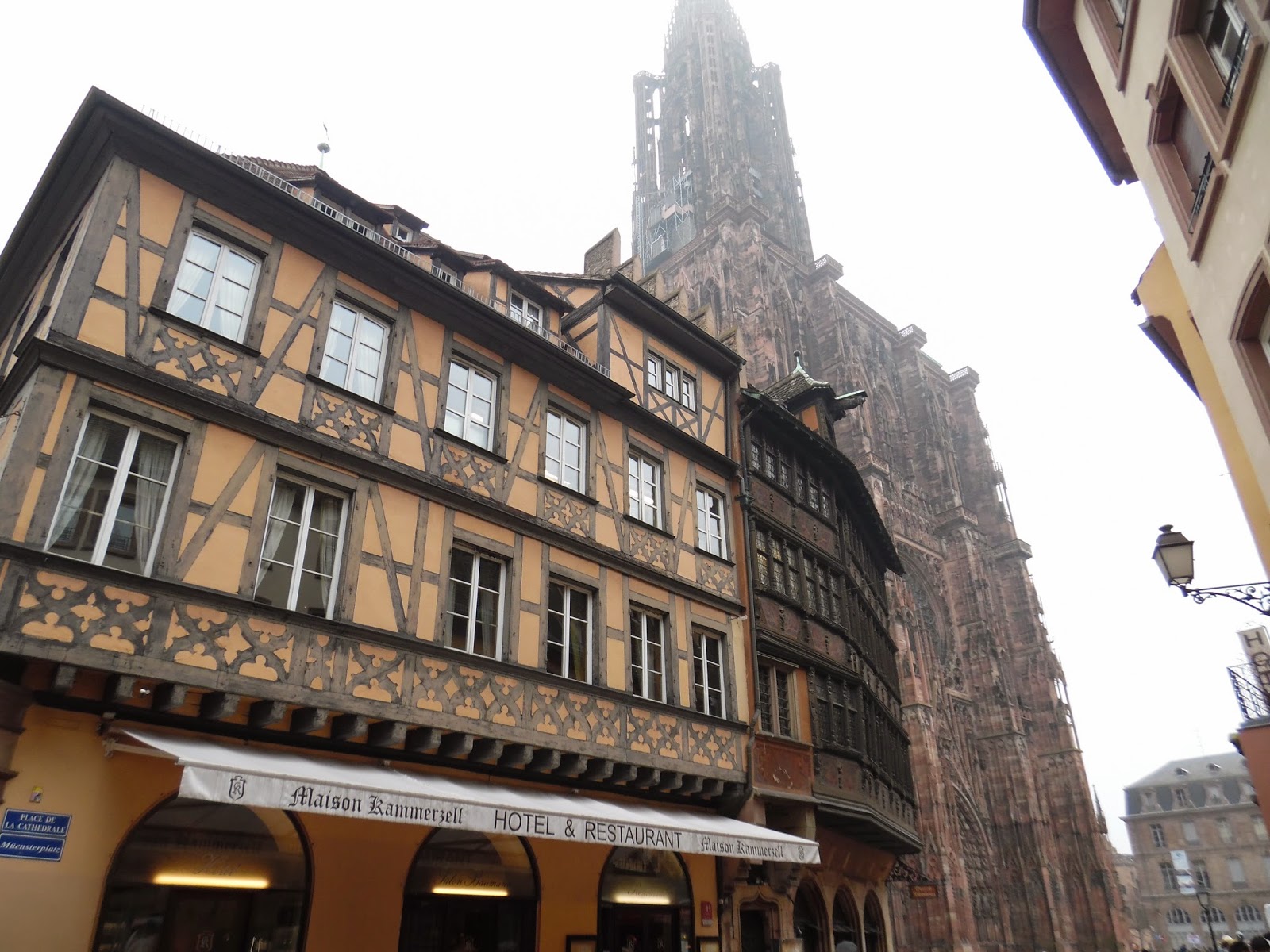
On the street right in front of the cathedral is a great biscuit and candy shop, where we got a fun little pail filled with hard candies:


At that point we took a lunch break and had sandwiches and eclairs in Mademoiselle's honor.  Hey M, don't the French bakery sandwiches look so much better than fast food lunch in the US?  


French eclairs are little bits of heaven.  Mmmmmmmm.


We finished out the trip with a stop at a kiosk for the magazine, and we found a lovely butterfly coloring book as well, and then headed to the grocery store for some mints, fancy mustard, candies, fig compote and good salt (I also picked up some crackers and cookies, but there was not room in the box).  

Here's the whole stash:

and here it is all boxed up:

It was like creating our own subscirption box.  Instead of an unboxing post, this is a boxing one!  I am always so backwards, aren't I?  It really was fun to get to go out and shop for all those little items--and a nice time to be in Strasbourg; a random Thursday in February is nice and quiet there in the plaza that is so often jam packed in warmer months.

I guess I will close by wishing a very happy 10th birthday to a very special Mademoiselle.  

--Hadley


Friday, February 6, 2015

So if vaccines don't cause autism, what does?

So, now that everyone is clear that vaccines do not cause autism, I am going to ramble on a bit about what I think might "cause" it.  This is purely rambling, based on nothing more than my own observations and common sense, etc.  It's not a soap box really, and it certainly isn't a fun post full of pretty pictures, just the insights (right or wrong, who knows?) of a mom.

There is a lot of talk these days about the spike in autism rates, and a lot of attempts out there to explain why this is happening, and why it happens more in some countries than others (the US being one of the "leaders" in this spike).

I think just about everyone can agree that the spike can be explained, in part, by more awareness and a tendency to diagnose higher functioning people who would never have a had a label beyond"quirky" or "weird" or "shy" etc., previously.

Nonetheless, the numbers are too high for this to be the only reason.  While there are, I am sure, many contributing factors, I think one of the big ones is NOT that there are more autistic people now, but rather that our society has changed in such a way that autistic individuals have a harder time coping and THAT leads to more times when people act in way that we identify as a problem and label as "autism"

Sensory overload:  We know that autistic people often struggle with sensory overload in one or more areas.  If you stop to think for a moment, we have a lot more sensory inputs to manage in the modern world than we ever did before.

 There is a much bigger variety of foods in a typical grocery store these days--from more fruits and vegetables (remember when kiwi was the "new" and popular fruit in the US in the 80s?  I do.) to a wider range of spices.

There are more sounds, from a greater variety of sources hitting our ears: the hum of computers, cell phones ringing in a myriad of tones, car alarms and electronic toys to name only a few. Most stores, or even schools (where we now consolidate more than one local neighborhood into a building) are busier, meaning there are just more individual sounds and sights in one space than there used to be.

Visually, more and more of the world we spend time in is specifically designed by advertisers and marketers to draw our attention to one thing or another and be visually striking or appealing in some way.

And most people have a greater radius that they cover in day to day life now than they did even 30 years ago--leading to simply seeing and hearing more in a given day that needs to be processed.  And so on.  All that processing of all that sensory input can be taxing for anyone, but especially for those who are extra sensitive to it.

Overwhelming Choice:  It can be very easy for autistic people to become overwhelmed making decisions.  Anxiety about making the wrong decisions, or even just not making the best one, can be debilitating.  And there are a lot of decisions to make these days.

Even toddlers, for the most part, have substantially more toys at home now than the typical two year old in the 80s did, much less in the fifties.  Simply choosing which toy to pick up and play with has become harder.  They probably have more clothes in their close, more acquaintances to choose to play with, more options when asked if they want to go for fast food, and even more choices of what to order once they get to the fast food place place than their counterparts of a generation or more back.  As you grow, the choices just multiply.  Which sport to take?  What club to join? Which grocery store to go to?  Even relaxing with a TV show is no longer about flipping on the TV when the show is on, it is deciding among literally thousands of options that can be streamed or put on DVD, etc at any time--which one do you choose?

Increasingly Complex Social Structures:  I grew up at a time when kindergarten was primarily about playing and learning social skills.  Even first and second grades involved a whole lot of art projects, parties and games, also aimed more at learning to be social than at academics.  Kids who struggle to grasp social skills intuitively were getting a huge help with this set up, and even the more socially intuitive kids probably ended up on more of the same page than they might have been otherwise.
In our push to raise test scores, we have put more and more emphasis on academics even in kindergarten, leaving less time for social training, a lack which is made all the worse by our increasingly difficult to navigate society.

Not that long ago, socializing outside of the immediate family stopped for nearly everyone around 8 or 9 pm and did not start up again until around 8 the next morning.  There was a decent amount of time to decompress from the pressures of the outside world.  These days, emails, texts, snapchats and the like fly at all hours of the day or night.  Even if a teen is required to shut down all of their electronics for the night, there is the worry and pressure of having to "catch up" on what happened through the night and early morning in order to be a part of the conversation at school the next day.
 And the conversations are so much more varied.  When I was in junior high, I could count on the conversation on Friday morning centering around what happened on Family Ties and The Cosby Show the night before.  The security of that kind of predictability is long gone now.
All of these various ways of communicating also have their own "rules" and norms to learn.  Kids today no longer have to master only the rules for communicating with other kids, family, and adults beyond family--the level of formality for adults varies from person to person much more than I recall from my own childhood: AND they have to learn to read tone not only in person and over the phone but in smilies and super short written comments (texts); etc.

Feeding an Obsession is Easier Than Ever: Autistic people are known for their tendency to obsess about one or more interests: from the kid who can tell you everything about every dinosaur to have once roamed the earth to the teen who can quote every line of Star Trek and is learning Klingon to the gentleman across the street who follows all developing weather patterns worldwide.  Just about everyone has hobbies and interests that can reach obsessive levels at times, but people with autism often take theirs just one step further and often struggle with understanding when or how to stop obsessing with knowing when that interest begins to dominate their lives in an unhealthy way or when to stop sharing their interest with a less interested friend, classmate or co worker.

I think now it is easier to be drawn into whatever you interest is, to the exclusion of too many other things, than the it was in the pre digital age.  Twenty or more years ago, to learn more about your hobby required going, in person, to a library or book store (which tended to be pretty small, without nearly as many titles on display as we have now) or magazine shop and hoping to find a new title you had not read before--but it was very often the case that there were no new titles on the shelf, or that you needed so save up for that nice book.  You might subscribe to a magazine that came chock full of exciting and new information that you would greedily devour once a month.  If you love a TV show, you would be sure to be home and tuned in every time it aired (on a nice, preset schedule--usually once a week).  Etc.
 Essentially, the somewhat limited availability of information put a natural limit on the extent to which one could devote time and attention to any one topic, and often some (at least minor) social interaction was required to gain more information.  Also, not being able to access information about your passion all the time, meant there was a lot more time spent doing other things, like honing social skills, or learning about topics that your friends and neighbors are interested in.
A person with a similar interest in the modern age can find nearly every title ever written on a subject just by going to amazon.com.  Many can be bought and read instantly on kindle or similar devices.  Not to mention the plethora of articles, vlogs, documentaries and other information available online, free of charge, 24 hours a day, seven days a week, 365 days a year.  Wow.
It can be hard for anyone to know when to stop, probably more so for someone autistic and who might be finding some temporary relief from anxiety while enjoying pursuing knowledge in an area they are passionate about.

Loss of Predictability: Yet another common trait among those with autism is that they like to know what to expect, either by clinging to a schedule or being told about a plan ahead of time, etc.  For people who are often overwhelmed by external stimuli and coping with social situations, being able to "practice" situations ahead of time, by predicting them and going through the motions in their imaginations, is really useful. And, of course, it is simply easier to cope with anything you have been through a few times before than a brand new situation.  Overall, life is not as predictable or routine these days as it was before the start of the "autism epidemic." Our ever increasing circles and technology, mean everything (from who you might encounter as a cashier at the grocery store, to what the topic of conversation in the school cafeteria over lunch to who your next door neighbor will be next year or what teacher you might have in 5th grade) is less predictable than it once was, which is just one more piece of constant low grade anxiety eating away at the coping reserves of many people.


Do I think the changing world, combined with a greater tendency to diagnose, accounts for 100% of the rise in autism rates?  No, but I think the two combined probably account for the majority of the rise.  I don't have a shred of science to back my hunches up, but I sure would love to see researchers starting to look at these possibilities.  If, indeed, we determine that autism is not a disease that can be cured, but rather, a personality that simply needs help learning to cope in our changing world, well, that opens up so many new and different ways of working to help people, and a whole new attitude in working with and discussing people who have this diagnosis doesn't it?  After all, should you really "diagnose" a personality?

--Hadley


Sunday, February 1, 2015

Six Years

Six years ago today, after an overnight flight and an exhausting layover in Dublin, we landed in Germany, ready to start the next chapter in our lives.


I think I was in a daze the entire day.  That day was preceded by just over two months of intense planning and preparation: deciding what to pack (we brought a total of 4 suitcases each), what to store and what to sell (most of our things), renting our house out (THAT turned out to be a complete disaster), gathering paperwork, saying goodbye to our wonderful friends in New Hampshire, and in what few spare moments we had left, trying to learn at least a few words of German.  I'd hardly slept for two months, did not manage any sleep on our flight, schlepped the heaviest carry-ons we've ever taken (before or since) for what seemed like a mile through the Dublin airport, and finally made it to FRA.

I think it was nearly a year before I really made it out of that daze.  We didn't move on a typical ex-pat package with the company shipping our things and paying for the kids to attend English speaking international schools and the like; other than one good friend who was kind enough to drive down often from her home an hour away, and always answer my frantic calls (I really don't know what we would have done without her), we were pretty much on our own.

In that first year, I learned a lot of things:

 I learned that German is a MUCH harder language to learn than Spanish.

I learned that schools here provide essentially no accommodations for children with learning disabilities. Being dyslexic makes it  pretty much a given that you will be placed in the lowest school track and only receive a 9th grade education.

I learned that it is surprisingly easy to find vegetarian food when dining out in the country known for its love of pork.

I learned that the above is not true in smaller towns in Bavaria, where I often made do with a side salad and plate of french fries.

I learned that German chocolate is vastly superior to American chocolate.

I learned to despise the German three tiered school system just as much as I dislike "No Child Left Behind" (it would be another year before I found out about and learned to love the German Waldorf schools).

I learned to love the amazing public health care provided for a very reasonable price.  We've never had such good doctors, such short waits to be seen and so little medical stress anywhere we lived in the US (though we did have an excellent GP in New Hampshire and also in Wyoming).

Most of all, I learned (or was reminded of) what I already knew: that I have an amazing family, one that loves one another immeasurably, and trusts each other and is a team.  I'm grateful for that every day.  That first year was hard.  David was travelling 80% of the time for work.  Every day was mentally exhausting just trying to keep our heads above water with the language.  We were struggling financially (thanks to the house in New Hampshire, and not one, but two sets of deadbeat tenants).

Six years later, David and I fit well here (though we STILL struggle with the language.  I was really naive about how difficult German would be for me).  We doubt we'll ever leave: we've obtained our permanent residency status and are considering buying a house.  Though, once the kids are out of school, we might well spend 3-6 months at a time in various countries so Dave can work on long term projects.

Marika's planning to return to the US this fall to start university.  I know she'll handle it well and do great; she's ready.  Part of me so so excited for her to be out there, making her own way in the world, but part of me is already missing her and our daily walks together.  It's going to be hard for me to leave her half a world away.

Rio also has permanent residency (new as of last week!) and just might stay in Germany as well.  Or, he might go back to the US for college and then come back here, or stay there.  Or he might work at a resort in Spain, then on a cruise ship, and then, who knows?  There's a whole world out there to explore and he is pretty interested in exploring it.

All in all, I think that leap of faith we took in moving was good for us.  The first year was exhausting and the second, well, rather brutal, but we made it through the hard parts and now we are all stronger, closer and more global (which has a lot of advantages).  I'm rather glad we took the plunge.

Six years. Wow.  Some days it feels like we're still new here, and on others I feel life before Germany was ages ago.

Here's hoping everyone is having a good Sunday, wherever in the world that this Sunday finds you,

--Hadley


Wednesday, January 28, 2015

Vaccinations--yes I am jumping on a soapbox again

I'm not sure what I find more surprising: that Germans, as safety conscious and detailed oriented as they are, do not require childhood vaccinations and have a relatively low rate of completing those, or that in the USA, where we technically require vaccination to attend school, the vaccination rate has fallen so low that in many places we are past the tipping point of providing herd immunity.

In either case, both countries have seen recent epidemics of measles (Germany in 2013, the US is in the midst of one now) that really should not be occurring in this day and age and in places with access to reliable healthcare.

There is talk in Germany about making vaccines compulsory for school (without the many easy outs the USA allows) and from what I can understand (as always, admitting freely that I miss many articles and don't always understand what I do see or hear) the two main reasons that Germany's rate is lower than it ought to be are:
1. Parents simply forgetting to take their kids in for the second MMR shot (this part would pretty well go away if parents had the reminder of needing to prove the kids had shots at school enrollment time)
2. A "natural medicine" movement in which some doctors feel children should have these diseases and build natural antibodies to them, experience high fevers while young to "get to know their bodies" etc (really people, really????!!!!)

Here is an article from 2013, written in English, that I found to explain a bit more, if anyone is interested:

http://www.dw.de/measles-rise-sparks-vaccine-debate-in-germany/a-16932413

Meanwhile, in the US many people are getting out of compulsory vaccination laws by claiming "religious exemptions" or personal objections (where such is allowed).  I know, from personal conversations with those who have done it, that many people have simply used this exemption, but do not actually belong to a religion which does not allow vaccinations.  So, I got curious and looked to see which religions actually ban vaccinations:  hmm it seems only the Dutch Reformed Church does (of any "major" religions, Dutch Reformed isn't even the main religion in The Netherlands and certainly not in the USA so major is kind of a stretch there):

http://www.skepticalraptor.com/skepticalraptorblog.php/religions-state-vaccines/

It turns out that many parents claiming religious exemption (and in some states that is not even required, you can simply state you object to the vaccines with no specific reason needed) do not belong to a religion that is opposed to vaccination and some do not belong to ANY church at all (and anti-vaccination sites encourage this, see link below for one of many examples):

http://articles.mercola.com/sites/articles/archive/2011/12/27/legal-vaccine-exemptions.aspx

So why are Americans REALLY not vaccinating their kids?  From what I have been able to ascertain it seems to come down to three major reasons:

1. Fear that vaccines cause autism (something ONE study showed and the idea took off like wildfire and even though that study has since been shown to have been full of false data and outright lies AND numerous other studies have been done which prove time and time and time again that autism is in fact not cause by the MMR vaccine, or any other vaccine, many people still seem to latch onto this fear. )

Here is a good link to an article about that which also links to many of the studies themselves:

http://www.autismsciencefoundation.org/autismandvaccines.html

Let me just repeat, in case you have somehow missed it: VACCINES DO NOT CAUSE AUTISM

2. Belief that vaccines are not needed and are just a "cash cow" for pediatricians and pharmaceutical companies.  This boggles my mind.  Measles, polio, mumps, etc were common, yes COMMON a century ago and the results were devastating to so many families.  I know that none of us parents making the decisions these days lived through that era, but it is easy enough to read about it, or talk to the elderly, who DID.  We KNOW vaccines are not just some money maker that doesn't work because they DID work, we did nearly eradicate diseases that once maimed and killed too many children.  So, even if they were huge money makers for drug companies and doctors, I'd still be in favour of them.  As is, they often cost a pediatrician's office more to give than the office gets paid, and there is such a low profit margin on them that very few companies will even make them these days.  They are not money makers, just life savers, plain and simple.
You'll find plenty of supporting articles about this if you google, here is one that sums it up short and sweet (and points out a number of other myths as well):

http://abcnews.go.com/Health/Wellness/12-myths-facts-vaccines/story?id=20213475

3. Fear of a serious adverse reaction to receiving a vaccination.  At least there is some validity to this.  Serious complications from receiving vaccinations ARE possible.  Not likely.  Much less likely than contracting the diseases they prevent and having a serious complication from those, but still possible.
This is the reason that ALL US states allow medical exemptions from vaccination requirements; some people should not receive certain childhood vaccinations: usually people who have had a serious (life threatening) allergic reaction to a prior vaccination of that kind or to any component of the vaccination, are on immunosuppressant drugs or have cancer.
NOTE: this says "people who" not siblings of people who, people who know someone who, etc.  In fact, not vaccinating those who will be in frequent contact with someone who cannot receive a vaccine only increase the risk of the person who is legitimately unable to be protected, as well as putting these other new people at risk themselves.
Here is a link to CDC reasons someone should not be vaccinated, if you want to read vaccine by vaccine:
http://www.cdc.gov/vaccines/vpd-vac/should-not-vacc.htm

And really, all three of the above reasons can be summed up into one reason: FEAR.  Completely IRRATIONAL FEAR, fear not backed up by any science and in fact refuted time and time again by science and simply looking at history.

I see it as much the same type of paranoia that I was blogging about a few months ago (here: http://hadleyswanderingsandramblings.blogspot.de/2014/09/land-of-paranoid.html ).  A small, but much bigger than it should be and VERY vocal percentage of the population grabbing onto something big and showy and hyped to be afraid of and basing decisions on that instead of clear, overwhelming logic and science that shows a different picture.

Normally I find this unfounded paranoia about oddball things worrisome, but when it comes to vaccinations I find it infuriating because when someone chooses not to vaccinate a child due to totally unfounded and false fears they are not only putting their own child at risk, they are putting every baby too young to be vaccinated, every person unable to be vaccinated and actually all of us  at risk (vaccines are not 100% effective, but when enough people have them the herd immunity protects the few for whom they did not work or cannot be vaccinated or have not yet been).  And while you should have the right to make silly, fear based decisions when it affects only you, I really don't think you ought to have the right to do the same if it leads to an epidemic.

So I am really hoping that Germany makes vaccinations a requirement, and that German doctors and parents get better at making sure second doses and boosters are not forgotten, and I hope the USA closes the loopholes that allow parents to opt out for any reason other than verified medical (hey, I'm even OK if verified long time members of the Dutch Reform Church are allowed to opt out--it is a small enough group that the risk is not much to the rest of us).  And until the law catches up with this, PLEASE; PLEASE; PLEASE check that you and your kids are up to date on your vaccines and make sure they are getting them (unless there is a true medical reason for that specific person not to).

Thanks,

Hadley


Thursday, January 22, 2015

A day in Split, Croatia

Our first day in Split was also predicted to be (and was) our warmest, and least windy.  So with the temp hovering right around freezing, minimal breeze and sunshine, we headed downtown near mid day.  Dave and I had been there on a cruise but the kids had never seen the pretty downtown area right on the water, built largely in the ruins of the palace of Diocletian.  It is a pretty awesome place and we were NOT going to miss it no matter what the weather, but it was extra nice to have some sun to enjoy it.

We drove into town and parked by the train station out on the water's edge..so we entered with lovely views of the waterfront area.  Palm trees!  Always a welcome site on a cold day:


Along the Riva there was a cute little beach themed Christmas market set up (more places to get drinks or snacks than selling actual products).  It was very pleasant and we stopped for a bit of that mulled white wine before heading further into the palace:


We spent the next couple of hours wandering the winding narrow streets and enjoying the 3rd and 4th century Roman ruins.  I think the photos speak for themselves, and I love this area so much that there are many.  I hope you enjoy them:


(yes, even some mosaic tile flooring still remains)

After an afternoon of sights like that, what else is there to do?  Well, we found an open restaurant and enjoyed some local seafood!


I definitely think Split is a "must see" kind of place, and really it is NICE being there in the cold because it meant we had that gorgeous plaza nearly to ourselves.  

--Hadley


Friday, January 16, 2015

Heading south, into Split, Croatia

As we continued south, the roads cleared and the snow stopped (but the wind picked up) and the sun came out just about the same time as we got our first glimpse of the sea:


As luck would have it, we were crossing over the Sibenik Bridge just at sunset.  There is a pullover on the southside of the bridge.  We braved the winds (70 kph) and cold (actually colder than the snowy areas had been) and got out to snap some photos:


Once again, Rio's photos were better (I think this will be the case from now on):


See that little village on the far side of the bridge?

Rio's camera has quite a good zoom--he got to try it out photographing that little village.

The rest of the drive was uneventful, other than increasingly high winds and we were checked into our side by side rooms at the Radisson Blu by dinner time.  I never did take any photos of the room, not sure why.  But every room is focused OUT, with outside walls being floor to ceiling glass and the bed and desk arranged to look towards them.  By morning we could see that even our less expensive "mountain view" rooms (as opposed to "sea view") had both a view of the sea, and a lovely view in general.  I loved those mountains dipping down into the Adriatic.  


--Hadley